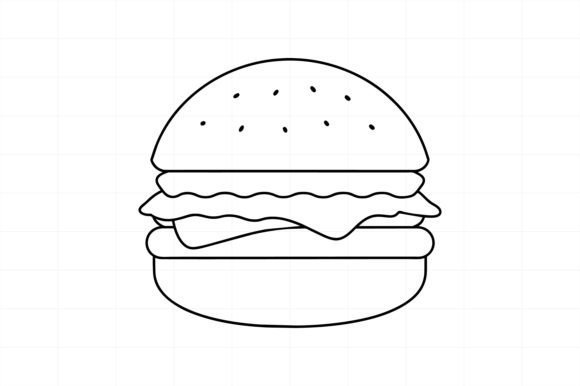
Burger Line Art Illustration
The Versatility of Minimalist Burger Graphics
What makes this specific type of graphic interesting is its structural honesty. Every ingredient—the bun, the patty, the lettuce, the cheese, the tomatoes—is represented by a distinct line. This segmentation is not just an artistic choice; it is a practical feature. When you download this burger clipart illustration, you are acquiring a flexible tool that can be deconstructed, recolored, or used as a solid unit.
Publishing, Education, and Interactive Content
In publishing, the practical uses are significant. An illustrator working on a children's book about food can use the line art as a base, adding characters or backgrounds around the structure. An educator creating a "Healthy Eating" worksheet can insert the PNG file directly into a document or presentation slide. The lack of color is a feature, not a limitation. It invites interaction.
- Coloring Books: The clear segmentation of ingredients provides natural zones for different colors. A thick, dark line weight helps prevent bleed-through and offers satisfying boundaries for both adults and children.
- Lesson Plans: Use the illustration for a cutting and pasting activity, a stencil for a classroom mural, or a visual aid for a lesson on food groups.
- Digital Storytelling: The PNG format with a transparent background allows you to drop the burger into different digital scenes, creating interactive e-books or learning modules.
Marketing, Branding, and Visual Identity
Marketers and small business owners thrive on visual consistency. Using this burger illustration across a website banner, a social media post, and a printed flyer creates a cohesive brand experience. The SVG file vector format ensures the image remains crisp on a 4K screen or a large-format poster. The transparent PNG allows for effortless compositing in tools like Canva, Photoshop, or Over.
Merchandise, Apparel, and Product Design
- T-Shirt Design: Use a single bold color for a screen print, or layer the SVG with textures for a unique distressed look.
- Wall Decor & Prints: A high-resolution PNG printed on quality paper creates an instant piece of modern kitchen or dining area art.
- Stickers & Labels: The simple shapes make it easy to produce kiss-cut or die-cut stickers that look professional and durable.
Creative Directions and Stylistic Explorations
Retro Diner Aesthetic: Use thick, consistent black lines with primary colors (red, yellow, white). This evokes a classic Americana feel that works well for burger joints and nostalgic merchandise.
Modern Minimalist: Keep the lines thin and consistent, using plenty of negative space. Print it on matte paper with a subtle color palette for wall decor that appeals to a contemporary audience.
Hand-Drawn Organic Feel: If the digital precision of the SVG feels too rigid, use it as a base to trace over by hand. This introduces natural imperfections that give the design warmth and authenticity, perfect for a cozy blog or a handcrafted product line.
Composition and Layout Considerations
For Hobbyists and Educators
For Designers and Entrepreneurs
If you are a designer or entrepreneur, time is money. Having access to a well-structured SVG file means you can treat this asset as a modular component of a larger system. You can adjust the line weights, change the stroke colors, or combine multiple illustrations to build a custom brand identity for a client in the food industry.
- Edit in Vector Software: Open the SVG in Adobe Illustrator, Affinity Designer, or Inkscape. Ungroup the elements to access individual ingredient lines.
- Create Variations: Generate a filled black version, a white knockout version, and a colorized version for different use cases.
- Build a Kit: Combine the burger art with related food icons to create a comprehensive branding kit for a restaurant or food blog.
Practical Guidance for Best Results
To get the most out of your Zipped folder, consider the final output medium before you start editing.
- For High-Resolution Print (Posters, Books, Decor): Use the PNG file at 300 DPI. This ensures sharp, clear edges and no pixelation on physical media.
- For Scalable Digital Use (Websites, Apps, Social Media): Use the SVG file. It scales perfectly to any screen size without increasing file size, keeping your website load times fast.
- For Custom Edits: Always start with the SVG. The vector paths give you the freedom to change anything—color, thickness, shape—without losing quality.