Pigeon Silhouette Vector Design: A Practical Asset for Creative Workflows
In the crowded landscape of visual assets, the pigeon silhouette vector design stands out as a remarkably versatile tool. Far from being just a simple bird graphic, a well-crafted pigeon silhouette serves as a building block for branding, merchandise, digital content, and print projects. Whether you are a small business owner creating a logo, a freelancer producing t-shirt graphics, or an educator putting together educational materials, these vector designs offer a clean, recognizable shape that adapts to countless contexts. This article explores what pigeon silhouette vector designs are, where they fit into real-world processes, and how to integrate them smoothly into your own workflow.
Understanding the Pigeon Silhouette Vector Design
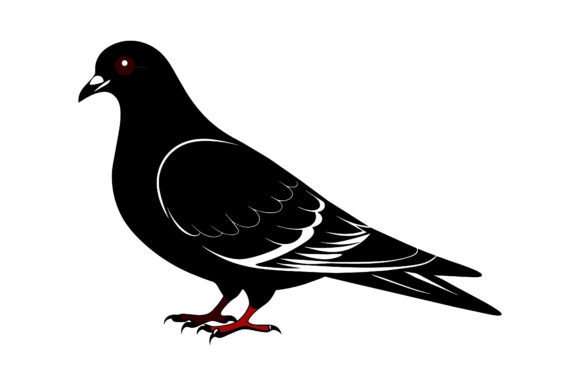
A pigeon silhouette vector design is exactly what it sounds like: a digital graphic that depicts the outline of a pigeon, filled with a solid color (typically black or white) and created using mathematical paths rather than pixels. This vector format means the design can be scaled from a tiny icon to a massive banner without any loss of quality. Unlike a raster image that becomes pixelated when enlarged, a vector silhouette remains crisp and sharp at any size. This makes it a reliable asset for both digital and print applications.
The pigeon itself is a universally recognized symbol—representing peace, home, urban life, or even freedom depending on context. A silhouette simplifies this symbol to its essential form, making it ideal for logos, crests, apparel, and minimalist illustrations. Because the design is a single continuous shape, it works beautifully on both light and dark backgrounds, especially when provided as a positive (black) or negative (white) version. Most professional vector packages, like the one described in the shop introduction, deliver the pigeon silhouette in multiple formats including AI, EPS, SVG, DXF, and PNG, giving you maximum flexibility for whatever tool or platform you use.
Where the Pigeon Silhouette Fits in Your Process
Integrating a pigeon silhouette vector design into your work is rarely a one-size-fits-all affair. Its role changes depending on the project phase and the end goal. Here are common scenarios where these designs prove most effective:
Pre-Production: Planning and Concept Development
Before you open your design software, the pigeon silhouette can serve as a reference or a placeholder. For example, if you are developing a logo for a transportation company or an urban brand, you might use the silhouette to test different layout options. Place it next to text, try different color schemes, or pair it with other graphic elements. Because the vector file is lightweight and easy to manipulate, you can quickly generate mock-ups without committing to a final design.
Practical tip: Create a library of silhouette variants (flying, walking, perched) from trusted sources. This saves you time during brainstorming because you already have a set of high-quality starting points. The commercial designs offered in shops often come with multiple angles, so you can select the one that best fits your concept.
During Production: Building the Final Asset
Once you have settled on a concept, the pigeon silhouette vector becomes a core component. Because it is 100% vector, you can easily modify its shape, add details, or merge it with other vectors. For instance, you could cut out the silhouette to create a stencil effect, embed a pattern inside the pigeon shape, or rotate and scale it to fit a specific canvas. The provided file formats—especially SVG for web work and AI/EPS for professional vector editors—ensure you can open the design in almost any application, from Adobe Illustrator to Inkscape or Affinity Designer.
Workflow example: Suppose you are designing a t-shirt for a local bookshop with a "pigeon reader" theme. You import the pigeon silhouette into your vector software, then use the Pen tool to add a pair of reading glasses. Because the base silhouette is smooth and closed, you can easily subtract shapes or combine them. The result is a unique graphic that feels custom-made, yet you built it on a foundation that took minutes to acquire.
After Production: Output and Distribution
After you finalize the design, the vector silhouette simplifies preparation for different outputs. For screen printing, you may need a black-only version—no problem, just set the fill to solid black and export as a high-resolution PNG or DXF for the separation process. For digital use, you can export a smaller SVG or PNG with transparency. The same file works for business cards, mugs, book covers, flyers, and social media banners because you can rescale it instantly.
Efficiency note: Because the design is resolution-independent, you avoid the common hassle of re-creating assets for different media. One vector file serves all purposes. This consistency also aids branding; your pigeon silhouette remains identical whether it appears on a website header or a printed sticker.
Interacting with Other Tools and Resources
Pigeon silhouette vector designs do not exist in isolation. They interact with your wider creative ecosystem—design software, printing equipment, online platforms, and even physical production processes. Understanding these interactions helps you choose the right format and prepare the file appropriately.
- Design software compatibility: Formats like AI (Adobe Illustrator native), EPS (legacy vector), and SVG (web standard) are supported by nearly every vector editor. If you use a niche tool like Procreate or Canva, you may prefer PNG or SVG. Always check your work environment before purchasing. The shop listed provides all five common formats, covering practically any scenario.
- Printing and cutting machines: For makers using vinyl cutters (Cricut, Silhouette Cameo), the DXF and SVG formats are ideal. These machines read vector outlines directly. A clean pigeon silhouette with no open paths cuts smoothly and reduces wasted material.
- Web and UI design: For websites, SVG is the best choice because it is small in file size, scalable without loading time, and can be styled with CSS. You can change the color of the pigeon silhouette on mouse hover or adapt it for dark mode—all without loading a new image.
- Collaborative workflows: If you work with a team, providing the design in AI or EPS ensures that other designers can open, edit, and reuse the asset without degradation. Cloud-based tools like Google Drive or Dropbox handle these files well.
Practical Implementation Tips
To get the most out of your pigeon silhouette vector design, consider these actionable strategies:
- Start with a clean file: Before editing, check the vector path for any stray points or irregularities. The commercial designs from reputable shops are usually clean, but it never hurts to verify. Use the “Simplify Path” command if you need to reduce nodes for smoother cutting or animation.
- Leverage color fills and gradients: Silhouettes are normally solid, but vectors allow you to apply gradients, patterns, or even transparency. For a modern look, try a two-tone gradient that transitions from dark gray to black. This adds depth while keeping the silhouette recognizable.
- Combine with typography and layout grids: A pigeon silhouette works exceptionally well as a graphic element beside text. Align it to the baseline or use it as a bullet point in a list. In a logo, it can sit above the wordmark. Experiment with negative space—for example, let the silhouette form part of a letter.
- Prepare for dark and white t-shirts: Since the shop highlights that their designs are easily customizable for dark or white shirts, you can quickly invert the fill or use a white cut for dark fabric. Keep a version with a uniform black fill for light shirts, and a white filled version for dark shirts. This two-file strategy saves production time.
- Test scalability: Even though vectors scale perfectly, always preview your design at the intended size. A silhouette that looks great at 2 inches might lose detail at 0.25 inches if the legs or beak are too thin. If needed, adjust stroke widths or merge small parts before finalizing.
Organizing Your Vector Library for Long-Term Use
Building a personal or business collection of vector assets, including pigeon silhouettes, pays dividends over time. Organize them in a logical folder structure: by subject (birds), by style (minimalist, realistic silhouette), and by format (SVG, AI, PNG). Use descriptive filenames like “pigeon_silhouette_flying_side.svg” so you can find files quickly later. Many shops provide multiple angles; keep them together in a subfolder.
Consistency across projects: If you run a brand that uses pigeon imagery repeatedly, standardize on one silhouette style. This builds visual recognition. Over time, you may modify the silhouette—adding a branch, a collar, or a subtle detail—but the core shape should remain recognizable. The vector format makes these edits reversible and non-destructive if you work with layers.
Quality Control and Usability Observations
Not all pigeon silhouette vector designs are created equal. When selecting a design from a shop, pay attention to the file’s structure. Does it have closed paths? Are the curves smooth? Is the silhouette truly one piece (no loose strokes)? The shop’s promise of “100% vector shapes” is a good sign, but you can verify by opening the file in a free viewer. A high-quality silhouette will allow you to change its color with a single click, and it will maintain its shape when scaled to extreme sizes.
Also consider the format relevance. For example, if you plan to use the design in a web project that requires animation (like a flying pigeon effect), SVG is essential because you can animate paths with CSS or JavaScript. For vinyl cutting, DXF remains a reliable standard. PNG is useful for quick previews or for clients who do not have vector editing software.
Real-World Workflow Example
Imagine you are a small business owner launching a line of urban-themed mugs. You want a simple yet striking design: a flock of pigeons silhouetted against a sunset-colored background. Here is how the pigeon silhouette vector design integrates into your production workflow:
- Step 1: Purchase a flying pigeon silhouette vector pack. You get multiple angles—side, top, front. Open them in your vector software.
- Step 2: Create a new document at the mug print area size (e.g., 8.5” x 3”). Place three pigeon silhouettes at different scales and rotations to create a natural flock effect.
- Step 3: Change the fill color of each pigeon to a deep black (or white if the mug base is dark). Add a subtle drop shadow behind them for depth.
- Step 4: Export as a high-resolution PDF for the mug printer. Also export a PNG mock-up for your online store.
- Step 5: Use the same vector files for a matching t-shirt design. Resize the flock to fill the chest area. Export as DXF for a vinyl cutter if you are making the shirts yourself.
This entire process—from file acquisition to final output—can be completed in under an hour because the vector silhouettes are ready to use, scalable, and customizable. The shop’s offering of multiple formats eliminates compatibility issues before they arise.
Long-Term Value and Integration
Pigeon silhouette vector designs are not one-off assets. They become part of your creative toolkit, ready to be reused, remixed, and repurposed. Over months and years, you will find new use cases: as an icon in a presentation, as a pattern repeated on wrapping paper, as a simple element in an infographic. Because they are stored in lossless vector formats, they never degrade.
For entrepreneurs and marketers, this means you can maintain brand consistency across all media without re-hiring designers for each new application. For educators and bloggers, a pigeon silhouette can illustrate concepts about urban wildlife, migration, or symbolism in a clean, professional way. For hobbyists, the design opens possibilities for personalized gifts, home decor, and craft projects that look polished.
Ultimately, the pigeon silhouette vector design is a humble but powerful component in a larger workflow. It streamlines the creation process, reduces repetitive tasks, and lets you focus on the creative decisions that matter. When you purchase from a shop that provides clean vectors in multiple formats, you are buying not just a graphic, but a time-saving resource that integrates seamlessly into your existing methods.
Explore the collection, pick a silhouette that matches your vision, and start implementing it right away. Whether your next project is a business card, a book cover, or a full merchandise line, a pigeon silhouette vector design can be the foundation upon which you build something distinctive and effective.